Real permit details can make a fake city invoice feel pre-verified
The FBI warned that criminals are timing professional-looking payment emails to active planning and zoning applications.
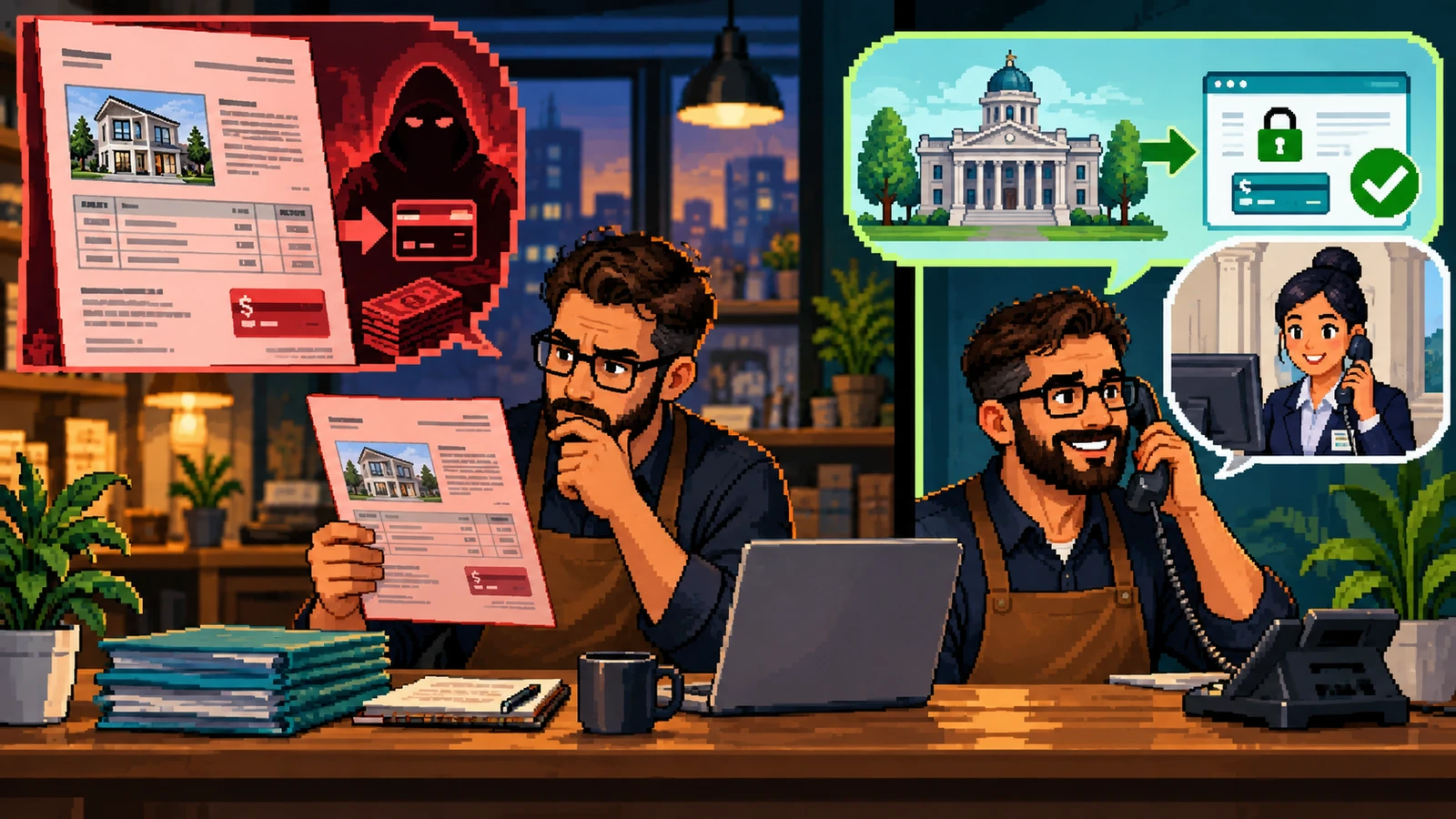
Property addresses, case numbers and official names can all be public. The FBI says criminals are combining those facts with copied government formatting and urgent invoices, then asking applicants to pay by wire, peer-to-peer service or cryptocurrency.
The message feels credible because it arrives during a real process and answers questions with accurate data. Public accuracy proves research, not identity. The most useful control is a call to the planning office using the number on the government website.
What FBI IC3, March 9, 2026 actually reported
FBI IC3, March 9, 2026 documents a current campaign or warning centered on real permit details can make a fake city invoice feel pre-verified. It describes the observed delivery route, the trust signal being borrowed and the action attackers wanted. We link the record in full so readers can separate reported facts about case number from our practical interpretation of email-only instruction.
The audience pain point is uncertainty at the exact moment a decision is required. The message feels credible because it arrives during a real process and answers questions with accurate data. Public accuracy proves research, not identity. The most useful control is a call to the planning office using the number on the government website. The safest response does not depend on winning a debate with the sender. It depends on moving the decision to a channel and record that existed before the new contact.
Borrowed signal
The sender has internal access.
Decision point
A reliable audit trail.
Defensive reset
Open the city or county website independently.
From “Case number” to “Email-only instruction”
Open the city or county website independently. That single boundary is more dependable than trying to judge confidence, polish or urgency.
Here, case number is the low-cost opening and email-only instruction is the high-impact destination. Reading each transition as a new capability makes the turning point visible before the story feels complete.
| Moment | What it appears to mean | What to verify |
|---|---|---|
| Case number | The sender has internal access | Is the same number publicly searchable? |
| Official name and seal | The department created the invoice | Does the sender domain match the government domain? |
| Payment deadline | The permit will be delayed | Does the portal show an outstanding fee? |
| Email-only instruction | A reliable audit trail | Why does the sender discourage a phone call? |
How to interrupt email-only instruction
Use the following sequence as a decision aid for real permit details can make a fake city invoice feel pre-verified, not as a test that must be completed while the sender waits.
- Open the city or county website independently.
- Call the published planning-office number.
- Compare fees with the official portal or prior invoice.
- Reject payment routes outside normal government methods.
- Preserve the PDF and full email headers.
- Warn the project team so a second contact cannot exploit the same case.
Recovery after email-only instruction
After email-only instruction, recovery starts by stopping the next irreversible action. Then preserve enough context to understand how the contact moved from case number to a consequential change.
- Ask the bank to stop or recall the payment.
- Notify the real planning department.
- File an IC3 report with case and payment details.
- Review other public project records for exposed contacts.
- Document the impersonated official and domain.
Why “Case number” can feel routine
In the sequence documented by FBI IC3, March 9, 2026, the story begins with context the recipient can recognize. It continues by explaining away normal friction. It succeeds only when the recipient completes the high-impact action. None of those stages requires carelessness. The approach behind “Real permit details can make a fake city invoice feel pre-verified” works by making the next action appear consistent with the role, project or relationship already in front of the recipient.
Training often overemphasizes spelling mistakes and theatrical urgency. In this case, the stronger question is whether the process has been quietly redesigned around the new contact. “Case number” may look routine, yet it can position “Email-only instruction” as the natural conclusion. A legitimate request should remain valid after a pause, a call-back and review by another authorized person.
Four decision points before “Email-only instruction”
1. Case number
Why it works: The sender has internal access. In a busy day, that explanation can be enough to keep the interaction moving. The safer test is narrower: Is the same number publicly searchable? This does not require the recipient to prove fraud. It only requires the sender’s claim to survive contact with a record or channel that the sender did not create.
What to notice after case number: Observe what changes at this point in “Real permit details can make a fake city invoice feel pre-verified.” Does the sender gain a reply, a session, a payment instruction, a new device, a document, or permission to continue? Naming the capability behind the sender has internal access is more useful than guessing the sender’s personality. It gives a colleague or incident team a concrete fact to verify instead of a vague feeling that this particular message looked wrong.
2. Official name and seal
Why it works: The department created the invoice. In a busy day, that explanation can be enough to keep the interaction moving. The safer test is narrower: Does the sender domain match the government domain? This does not require the recipient to prove fraud. It only requires the sender’s claim to survive contact with a record or channel that the sender did not create.
What to notice after official name and seal: Observe what changes at this point in “Real permit details can make a fake city invoice feel pre-verified.” Does the sender gain a reply, a session, a payment instruction, a new device, a document, or permission to continue? Naming the capability behind the department created the invoice is more useful than guessing the sender’s personality. It gives a colleague or incident team a concrete fact to verify instead of a vague feeling that this particular message looked wrong.
3. Payment deadline
Why it works: The permit will be delayed. In a busy day, that explanation can be enough to keep the interaction moving. The safer test is narrower: Does the portal show an outstanding fee? This does not require the recipient to prove fraud. It only requires the sender’s claim to survive contact with a record or channel that the sender did not create.
What to notice after payment deadline: Observe what changes at this point in “Real permit details can make a fake city invoice feel pre-verified.” Does the sender gain a reply, a session, a payment instruction, a new device, a document, or permission to continue? Naming the capability behind the permit will be delayed is more useful than guessing the sender’s personality. It gives a colleague or incident team a concrete fact to verify instead of a vague feeling that this particular message looked wrong.
4. Email-only instruction
Why it works: A reliable audit trail. In a busy day, that explanation can be enough to keep the interaction moving. The safer test is narrower: Why does the sender discourage a phone call? This does not require the recipient to prove fraud. It only requires the sender’s claim to survive contact with a record or channel that the sender did not create.
What to notice after email-only instruction: Observe what changes at this point in “Real permit details can make a fake city invoice feel pre-verified.” Does the sender gain a reply, a session, a payment instruction, a new device, a document, or permission to continue? Naming the capability behind a reliable audit trail is more useful than guessing the sender’s personality. It gives a colleague or incident team a concrete fact to verify instead of a vague feeling that this particular message looked wrong.
Where workplace deception needs protective friction
The first protective move is simple: Open the city or county website independently. The second is procedural: Call the published planning-office number. Together, those moves separate the sender’s narrative from the organization’s evidence. They are deliberately slower than clicking Reply, but much faster than recovering money, identity access or a compromised device.
The next layer is social. Compare fees with the official portal or prior invoice. People bypass controls when they believe delay will disappoint a customer, executive or colleague. A good policy therefore grants explicit permission to pause and defines who owns the follow-up. The recipient should not have to investigate alone while the requester waits on the line.
Evidence to retain after “Case number”
Evidence about real permit details can make a fake city invoice feel pre-verified is most useful when it captures the original route and the requested action. Do not keep chatting simply to make the sender confess. Save what already exists, note what was approved or disclosed, and move reporting to a trusted channel. The following details give responders a workable starting point:
- Ask the bank to stop or recall the payment
- Notify the real planning department
- File an IC3 report with case and payment details
- Review other public project records for exposed contacts
A screenshot can communicate the visible story around case number, but the original message, full sender address, link, meeting invitation or transaction reference may contain more useful technical detail. Preserve both when it is safe to do so. Avoid forwarding suspicious material around the organization; use the approved reporting method so the artifact behind email-only instruction does not become a second exposure.
A two-minute response before “Email-only instruction”
Stop before the highest-impact request: open the city or county website independently. Leave the sender’s route, then check the claim in a system or contact record you already trust. If it is genuine, resume through the verified process; if it is not, report the original interaction and warn the people most likely to receive the same workplace deception pretext. That sequence works even when the message is polished or the screen belongs to a legitimate service.
What workplace deception teams should change
Teams should turn this case into one explicit rule and one known reporting route. The rule is: open the city or county website independently. The reporting route should collect the original message, channel, time and requested action without asking the employee to continue engaging.
The costume around case number will change with the next news cycle. The verification boundary before email-only instruction should not. Separate the claim from the route used to prove it, and make that consequential action wait for independent confirmation.
This article links to FBI IC3, March 9, 2026, paraphrases its findings about real permit details can make a fake city invoice feel pre-verified, and labels the decision framework as editorial analysis rather than presenting inferred details as observed facts.